
Playing cards are far more than simple pieces of printed cardstock. Whether you are creating a premium deck for a casino, designing promotional cards for your business, developing collectible trading cards, or producing branded merchandise, understanding playing card dimensions is one of the most important steps in the manufacturing process. Choosing the right size affects usability, printing quality, storage, packaging, shipping costs, and the overall customer experience.
At Packaging Aazz, businesses across the United States trust high-quality packaging solutions to protect and showcase custom printed products. Whether you need premium boxes for playing cards or complete retail packaging, exploring solutions through Packaging Aazz helps ensure your products make an excellent first impression.
This comprehensive guide explains everything you should know about playing card dimensions in the USA, from standard sizes to custom options, printing recommendations, packaging choices, and how selecting the right dimensions can strengthen your brand.
Why Playing Card Dimensions Matter
Many people assume all playing cards are identical in size. In reality, manufacturers produce cards in several dimensions depending on their intended purpose.
The correct playing card dimensions influence:
- Player comfort
- Card handling
- Durability
- Printing accuracy
- Packaging efficiency
- Shipping expenses
- Retail shelf presentation
Whether you’re producing poker cards, educational flash cards, promotional decks, or luxury collector editions, selecting suitable dimensions from the beginning prevents unnecessary production problems later.
Companies that already invest in products like custom packaging usa understand that proper sizing is just as important as attractive design.
Standard Playing Card Dimensions in USA
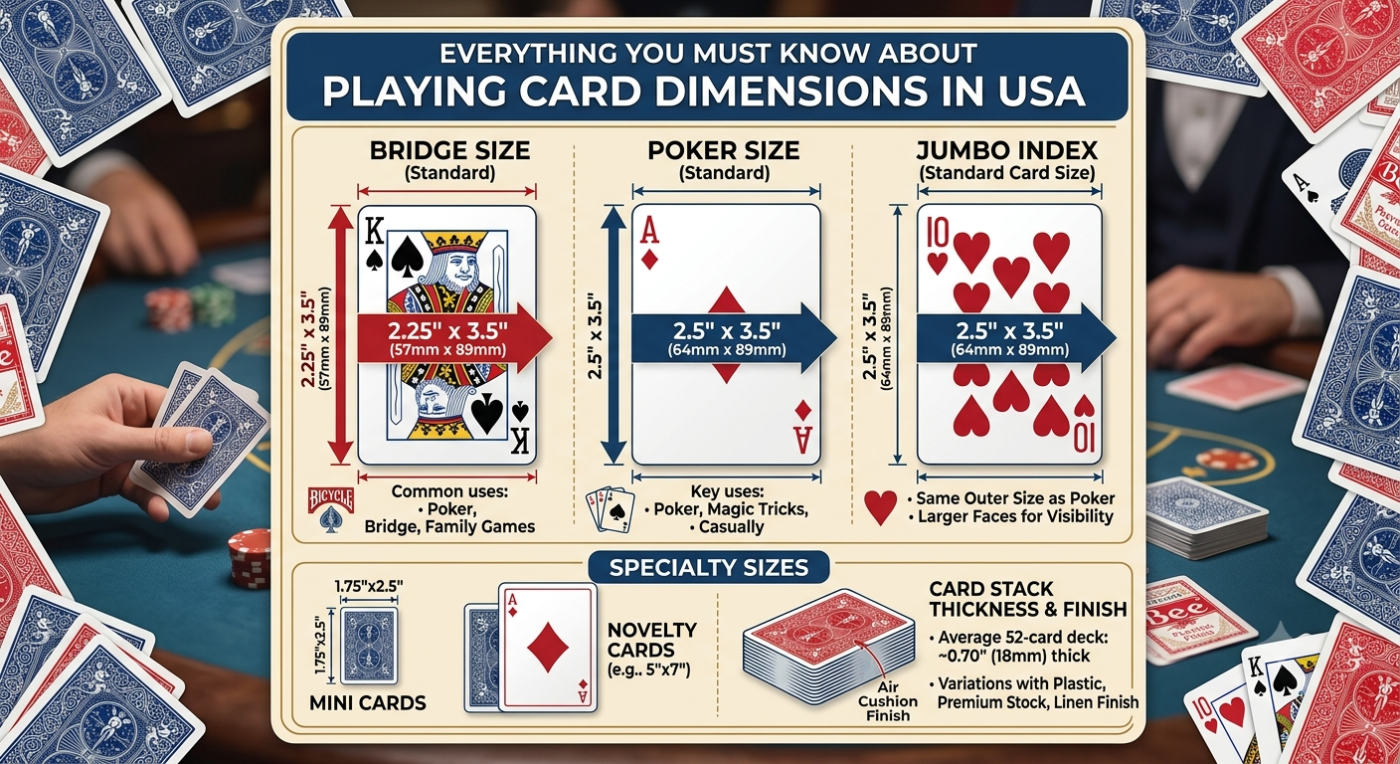
The United States has several commonly accepted playing card sizes. These dimensions have become industry standards because they provide an ideal balance between readability and handling.
| Card Type | Inches | Millimeters | Common Uses |
|---|---|---|---|
| Poker Size | 2.5 × 3.5 | 63.5 × 88.9 mm | Casinos, tournaments |
| Bridge Size | 2.25 × 3.5 | 57 × 88.9 mm | Bridge games |
| Mini Cards | 1.75 × 2.5 | 44 × 64 mm | Travel games |
| Jumbo Cards | 3.5 × 5 | 89 × 127 mm | Educational games |
| Tarot Cards | 2.75 × 4.75 | 70 × 120 mm | Tarot reading |
Among these, poker-size cards remain the most popular option in the USA because they offer excellent visibility while remaining easy to shuffle.
Understanding Standard Poker Card Dimensions
Poker cards have become the benchmark for many custom card projects.
Standard poker cards measure:
- Width: 2.5 inches
- Height: 3.5 inches
- Radius corners
- Smooth or linen finish
These dimensions provide enough surface area for:
- Logos
- Artwork
- QR codes
- Brand messaging
- Custom illustrations
Many companies creating promotional card decks choose poker dimensions because consumers are already familiar with their feel.
Businesses launching promotional products often pair them with custom gift boxes wholesale usa for premium retail presentation.
Bridge Card Dimensions
Bridge cards share the same height as poker cards but are slightly narrower.
Typical measurements include:
- Width: 2.25 inches
- Height: 3.5 inches
The reduced width allows players to comfortably hold larger hands of cards.
Bridge cards remain popular among:
- Senior communities
- Card clubs
- Educational institutions
- Traditional game publishers
Their compact profile can reduce packaging material requirements, making them efficient for shipping.
Mini Playing Card Dimensions
Mini cards continue growing in popularity due to their portability.
Common measurements include:
- 1.75 × 2.5 inches
These cards are frequently used for:
- Party games
- Promotional giveaways
- Children’s games
- Travel editions
- Compact educational kits
Manufacturers often package these decks inside custom party favor boxes usa because they create attractive presentation for weddings, birthdays, and corporate events.
Quote now
Jumbo Playing Card Sizes
Some products require larger cards for easier reading or classroom demonstrations.
Popular jumbo dimensions include:
- 3.5 × 5 inches
- 4 × 6 inches
Large cards benefit:
- Teachers
- Trainers
- Game instructors
- Seniors
- Children
Larger artwork provides greater flexibility for branding and colorful illustrations.
Custom Playing Card Dimensions
Not every project should use industry-standard measurements.
Many brands develop unique dimensions to differentiate their products.
Examples include:
- Square cards
- Circular cards
- Extra-long cards
- Fold-out cards
- Oversized collector editions
Custom sizing allows businesses to create memorable customer experiences while supporting creative artwork.
Businesses investing in premium branding frequently combine these projects with custom packaging los angeles usa for luxury retail presentation.
Card Thickness Matters Too
Dimensions involve more than width and height.
Thickness significantly affects durability.
Common cardstock thickness includes:
| Thickness | Typical Use |
|---|---|
| 280 GSM | Budget decks |
| 300 GSM | Promotional cards |
| 310 GSM | Professional decks |
| 330 GSM | Premium gaming cards |
| 350 GSM | Luxury collector editions |
Higher GSM usually provides:
- Better durability
- Improved shuffle quality
- Enhanced printing
- Premium customer perception
Bleed Area and Safe Zone
Professional printing requires extra design space.
Most manufacturers recommend:
- 3 mm bleed
- 3–5 mm safe zone
- Rounded corners
This prevents:
- White edges
- Cropped artwork
- Misaligned borders
Professional artwork preparation reduces waste and improves production efficiency.
Choosing the Best Finish
Playing card dimensions work together with surface finishing.
Popular finishes include:
- Matte
- Gloss
- Linen
- UV coating
- Soft-touch laminate
Each finish changes how cards feel during gameplay.
Premium brands frequently select soft-touch coatings because they improve grip while adding luxury appeal.
Luxury products often receive matching packaging using luxury jewelry packaging usa-inspired design principles that emphasize elegance and premium presentation.
Best Materials for Playing Cards
Several materials dominate modern card production.
| Material | Advantages | Best For |
|---|---|---|
| Paperboard | Affordable | Standard decks |
| Black-core cardstock | No light transmission | Professional cards |
| Plastic PVC | Waterproof | Casinos |
| Composite stock | Durable | Premium games |
| Recycled board | Eco-friendly | Sustainable brands |
The material should complement both the intended use and the packaging style.
Eco-conscious businesses increasingly pair recycled cards with custom packaging california usa solutions designed with sustainable materials.
Packaging for Playing Cards
Even perfectly sized cards need protective packaging.
The box should:
- Prevent bending
- Resist moisture
- Support stacking
- Enhance shelf appeal
- Protect corners
A well-designed package often determines whether consumers perceive the product as premium.
Packaging Aazz offers numerous custom packaging options suitable for playing card decks, including tuck boxes, rigid boxes, magnetic closures, and collector packaging available through Packaging Aazz.
Brands seeking retail-ready solutions often explore retail packaging usa to improve product visibility while protecting cards during transportation.
How Playing Card Dimensions Affect Packaging Design
Packaging designers must consider several measurements beyond the card itself.
These include:
- Card stack height
- Insert thickness
- Protective coating
- Plastic wrap allowance
- Retail hanging options
An oversized box wastes material, while a box that’s too tight can damage the cards.
Professional structural design balances protection with manufacturing efficiency.
Many specialty products—including cosmetics, supplements, vape products, and collectible games—follow similar dimensional planning principles used in custom cosmetic packaging usa and premium retail packaging.
Retail Display Considerations
Retail shelves demand packaging that attracts attention immediately.
Good packaging should:
- Display branding clearly
- Fit standard shelving
- Resist crushing
- Stack efficiently
- Protect corners during shipping
For limited-edition decks, premium rigid packaging may significantly improve perceived value and customer satisfaction.
Many luxury promotional products adopt techniques similar to custom jewelry packaging usa to create an unforgettable unboxing experience.
Custom Printing Options for Playing Cards
Modern printing technology allows brands to create highly customized decks while maintaining accurate playing card dimensions.
Popular customization options include:
- Full-color printing
- Metallic foil accents
- Embossing
- Spot UV
- Holographic finishes
- Edge coloring
- Personalized backs
- Variable data printing
These enhancements help businesses transform an ordinary deck into a memorable branded product while maintaining compatibility with standard packaging sizes.
What is the standard playing card size in the USA?
The most common size you’ll see in the USA is the poker playing card dimension, which measures 2.5 × 3.5 inches. This size is widely used in casinos, tournaments, and most commercial card games because it gives a comfortable balance between readability and ease of handling. When you’re designing or ordering your own deck, sticking to standard sizing helps ensure your cards feel familiar and professional right away. If you go too large or too small, it can change how players shuffle and hold the cards, which affects the overall experience.
When brands create custom decks, they often pair them with professional packaging from custom packaging usa. This helps keep the product aligned with retail expectations and protects the cards during shipping. Businesses working with Packaging Aazz usually choose standard dimensions first, then customize artwork, finishes, and packaging design. The key is consistency—when your card size matches industry standards, everything from printing to packaging becomes smoother and more cost-effective.
Why are poker playing card dimensions the most popular?
Poker playing card dimensions are the industry standard because they simply work best for most users. At 2.5 × 3.5 inches, the cards are large enough to display artwork clearly but still compact enough for easy shuffling and handling. Whether you’re designing a casino deck or a branded promotional set, this size feels natural in people’s hands, which is a big reason it dominates the market.
Many businesses use this size when creating custom products and then elevate the presentation using retail packaging usa solutions. The packaging helps position the cards as premium products instead of simple game tools. Brands working with Packaging Aazz often combine poker-sized decks with high-end finishes like matte coating or foil stamping for added impact. Since customers already recognize this size, it reduces confusion and increases acceptance, making it a safe and reliable choice for both beginners and professional manufacturers.
What is the difference between poker and bridge card sizes?
The main difference between poker and bridge playing card dimensions is the width. Poker cards are 2.5 inches wide, while bridge cards are slightly narrower at 2.25 inches. Both share the same height of 3.5 inches, but that small change in width makes a noticeable difference in how they feel during gameplay. Bridge cards are easier to hold in large quantities, which is why they are often preferred for games that require players to manage many cards at once.
When creating custom decks, businesses often match the card type with appropriate packaging from custom packaging los angeles usa. Proper packaging ensures both sizes are protected and presented well on shelves. Companies using Packaging Aazz typically choose bridge cards for traditional games and poker cards for modern or commercial designs. The choice between them comes down to user comfort, gameplay style, and how the product will be positioned in the market.
What are mini playing cards used for?
Mini playing cards are much smaller than standard decks, usually measuring around 1.75 × 2.5 inches. These compact cards are often used for travel games, party favors, promotional giveaways, and kids’ activities. Because of their size, they are easy to carry and store, making them perfect for on-the-go entertainment. However, the smaller size also means less space for detailed artwork, so designs need to be simplified and bold.
Many brands package mini decks inside custom party favor boxes usa to make them more attractive for events like weddings, birthdays, and corporate giveaways. When working with Packaging Aazz, businesses often combine mini cards with colorful packaging to increase appeal. Even though they are small, mini cards still follow the same design principles as standard decks, including bleed zones and safe printing margins. The right packaging makes them feel like a premium gift rather than a simple novelty item.
What materials are best for playing cards?
Playing cards can be made from several different materials, and the choice depends on durability, budget, and intended use. Most standard decks use paperboard or cardstock, while premium decks use black-core or composite materials that prevent light from passing through. Casinos often prefer plastic PVC cards because they are waterproof and long-lasting, while collectors usually go for thicker, textured cardstock for a luxury feel.
Material selection also affects packaging needs. For example, premium cards often require stronger protection similar to custom luxury packaging usa styles to maintain quality during shipping and retail display. Brands working with Packaging Aazz often choose materials based on customer expectations and price point. Eco-friendly options like recycled board are also becoming more popular, especially for brands focused on sustainability. The material you choose directly influences durability, print quality, and how your final product is perceived in the market.
How thick should playing cards be?
Card thickness is measured in GSM (grams per square meter), and it plays a big role in how your cards feel and perform. Most standard playing cards range between 280 GSM and 350 GSM. Lower GSM cards are more flexible and budget-friendly, while higher GSM cards feel sturdier and more premium. If you want cards that last longer and shuffle smoothly, a thickness of around 310–330 GSM is often ideal.
Thickness also impacts packaging design, especially when stacking multiple decks inside a box. Many brands align their products with packaging solutions similar to custom cosmetic packaging usa because structural strength matters just as much as appearance. Businesses using Packaging Aazz often test different thickness levels before final production to ensure the best user experience. The goal is to find the right balance between durability, flexibility, and cost without compromising gameplay quality or packaging efficiency.
What is bleed area in playing card printing?
Bleed area is the extra space around your card design that ensures no white edges appear after cutting. Typically, printers require around 3 mm of bleed on all sides of a playing card. This extra margin allows slight movement during cutting without affecting the final artwork. Without proper bleed setup, your design might end up uneven or cropped incorrectly.
When designing cards for production, businesses often follow the same precision standards used in custom packaging usa projects. Accuracy is critical because even small errors can affect the entire batch. Companies working with Packaging Aazz ensure that bleed, safe zones, and alignment are carefully checked before printing begins. This helps maintain consistency across thousands of cards. If you’re creating a professional deck, understanding bleed is just as important as choosing the right playing card dimensions because it directly affects print quality and visual balance.
Can playing card dimensions be customized for branding?
Yes, playing card dimensions can be fully customized if you want your product to stand out. While poker size is the industry standard, many brands choose unique shapes and sizes for promotional purposes or collectible editions. Custom dimensions allow you to create a distinctive product experience that reflects your brand identity and attracts attention on store shelves.
Brands often combine custom sizing with packaging solutions like retail packaging usa to ensure the final product looks polished and professional. Companies working with Packaging Aazz frequently experiment with non-standard sizes for marketing campaigns, limited editions, and gift sets. However, it’s important to balance creativity with usability—cards that are too large or too small can affect gameplay. Custom dimensions work best when you want to create a premium or collectible feel rather than a standard gaming experience.
What finish options are available for playing cards?
Playing cards come in several finishes, and each one changes how the cards feel and perform. The most common finishes include matte, gloss, linen, UV coating, and soft-touch laminate. Matte finishes reduce glare and improve grip, while gloss finishes make colors more vibrant. Linen textures provide a classic casino feel, and UV coatings add durability and shine.
Finish selection is often tied to branding and packaging strategy. For example, premium decks may be paired with elegant packaging similar to custom jewelry packaging usa to create a luxury experience. Businesses using Packaging Aazz often test different finishes to match their target audience. A simple promotional deck might use a basic matte finish, while a collector’s edition might use foil stamping and soft-touch coating. The right finish enhances both the visual appeal and tactile experience of your cards.
How do playing card dimensions affect packaging design?
Playing card dimensions directly determine how your packaging is designed. The box must fit the exact size of the card stack while leaving enough room for inserts, wrapping, or protective coatings. If the packaging is too tight, it can damage the cards, and if it’s too loose, the product may shift during transport.
This is why many brands rely on professional packaging solutions like custom packaging usa to ensure precision. Companies working with Packaging Aazz carefully measure card height, thickness, and finish before designing the final box. Even small changes in dimensions can affect structural design and material choice. Proper alignment between card size and packaging ensures durability, reduces waste, and improves customer satisfaction. In retail environments, well-fitted packaging also makes the product look more premium and trustworthy on the shelf.
